> ## Documentation Index
> Fetch the complete documentation index at: https://docs.generect.com/llms.txt
> Use this file to discover all available pages before exploring further.
# Email Validation
> Validate existing email addresses for deliverability
The Email Validation module is designed to check *existing* email addresses and determine whether they are valid, invalid, or belong to catch-all domains.\
Unlike the **Email Finder**, this tool does not generate an email – it only validates the one you already have.
## How Generect Validates Emails
Generect performs a multi-layered validation process to ensure maximum accuracy for every email address.
**Validation process:**
 ### Syntax Check
Verifies whether the email is written correctly (presence of "@", domain format, allowed characters, etc.).
### SMTP Verification (core step)
Generect sends a request to the email server to determine:
* whether the mailbox exists
* whether the server accepts mail
* whether the domain is configured as catch-all
The server returns a confirmation or rejection response.
### Catch-All Detection
If a domain accepts all emails – even for non-existing addresses – Generect marks it as **Catch-All**.
### Additional Signals
The system also analyzes:
* historical deliverability data
* previous validation results
* domain behavior patterns
This helps improve accuracy when servers use strict anti-spam or anti-bot protection.
## Possible validation statuses
* **Valid** – the address exists; the server confirmed mail acceptance.
* **Invalid** – the mailbox does not exist or the server rejected it.
* **SMTP** – the server does not provide a clear response (common on protected domains).
* **Catch-all** – the domain accepts any email, real or not; true deliverability is uncertain.
* **Unknown** – the server did not respond or provided an ambiguous response.
## What the user receives
* A clear validation status (Valid / Invalid / Catch-All / SMTP / Unknown)
* Technical verification details
* Automatic logging in **Validation History**
* Ability to export, filter, and clean lists based on validation results
## How to Validate a Single Email (Email Validator)
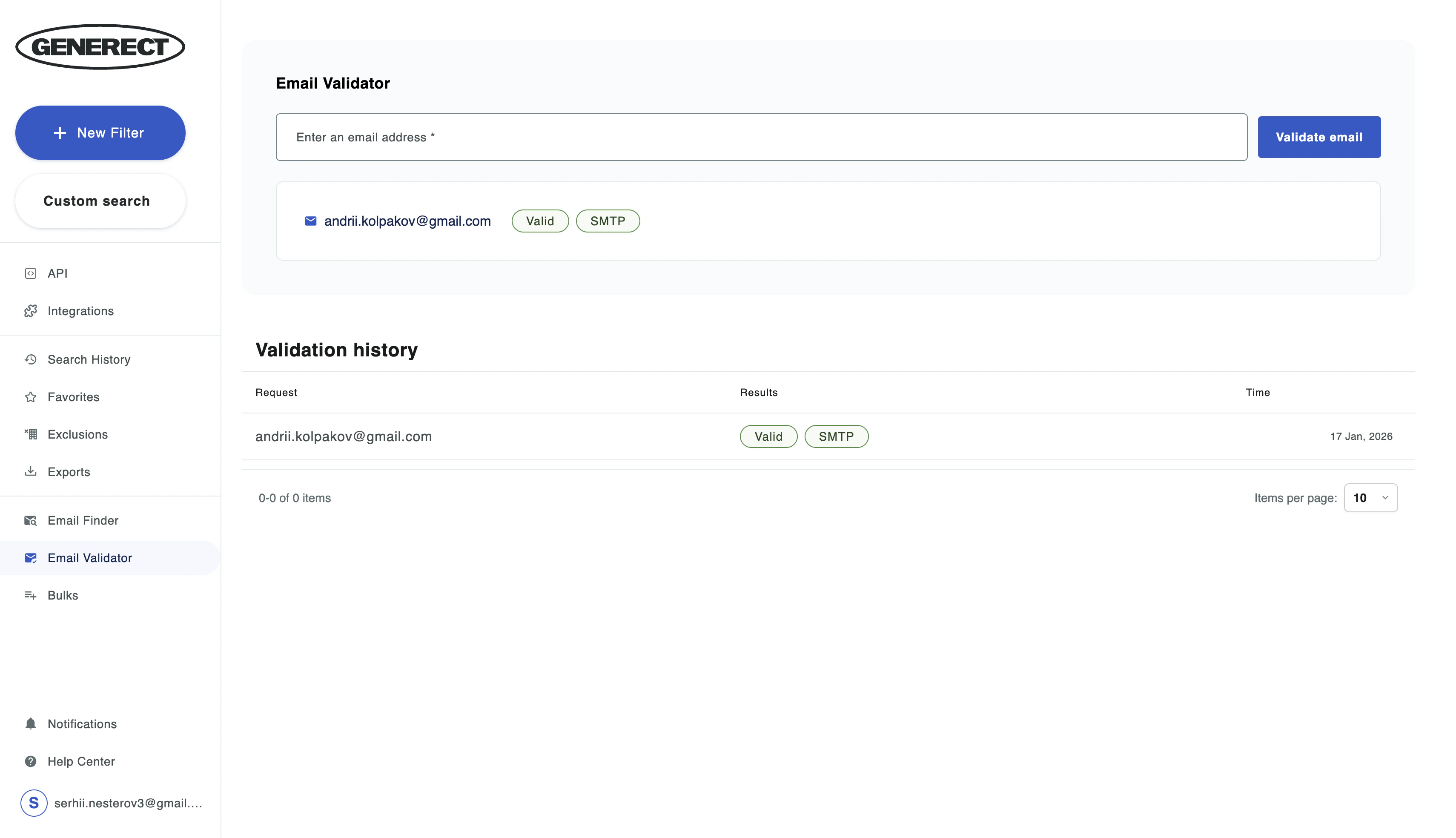
The **Email Validator** section allows you to manually check one email at a time.
**How it works:**
1. Go to **Email Validator**.
2. Enter an email address into the form.
3. Click **Validate email**.
4. The system performs an SMTP check and displays the result.
**Results appear in a table showing:**
* Email
* Status (Valid / Invalid / Catch-all / SMTP / Unknown)
* Validation date
All validated emails are saved in your **Validation History**.
## Bulk Email Validation
This module is used when you already have a list of email addresses and want to validate them all at once.
**How to run Bulk Validation:**
1. Go to **Bulks → Bulk email validation**.
2. Upload a CSV or XLSX file containing:
* **Email**
3. Click **Upload file**.
4. The system processes each email individually.
5. Results appear in the table and are available for export.
**What Generect returns**
For each email:
* Status: **Valid / Invalid / Catch-all / Unknown / SMTP**
* Validation source
* Date of validation
Summary statistics:
* % of valid emails
* count of catch-all addresses
* count of invalid addresses
* number of unknown / SMTP results
You can download the cleaned list using the **Export** button.
Learn about advanced validation for catch-all domains
### Syntax Check
Verifies whether the email is written correctly (presence of "@", domain format, allowed characters, etc.).
### SMTP Verification (core step)
Generect sends a request to the email server to determine:
* whether the mailbox exists
* whether the server accepts mail
* whether the domain is configured as catch-all
The server returns a confirmation or rejection response.
### Catch-All Detection
If a domain accepts all emails – even for non-existing addresses – Generect marks it as **Catch-All**.
### Additional Signals
The system also analyzes:
* historical deliverability data
* previous validation results
* domain behavior patterns
This helps improve accuracy when servers use strict anti-spam or anti-bot protection.
## Possible validation statuses
* **Valid** – the address exists; the server confirmed mail acceptance.
* **Invalid** – the mailbox does not exist or the server rejected it.
* **SMTP** – the server does not provide a clear response (common on protected domains).
* **Catch-all** – the domain accepts any email, real or not; true deliverability is uncertain.
* **Unknown** – the server did not respond or provided an ambiguous response.
## What the user receives
* A clear validation status (Valid / Invalid / Catch-All / SMTP / Unknown)
* Technical verification details
* Automatic logging in **Validation History**
* Ability to export, filter, and clean lists based on validation results
## How to Validate a Single Email (Email Validator)
The **Email Validator** section allows you to manually check one email at a time.
**How it works:**
1. Go to **Email Validator**.
2. Enter an email address into the form.
3. Click **Validate email**.
4. The system performs an SMTP check and displays the result.
**Results appear in a table showing:**
* Email
* Status (Valid / Invalid / Catch-all / SMTP / Unknown)
* Validation date
All validated emails are saved in your **Validation History**.
## Bulk Email Validation
This module is used when you already have a list of email addresses and want to validate them all at once.
**How to run Bulk Validation:**
1. Go to **Bulks → Bulk email validation**.
2. Upload a CSV or XLSX file containing:
* **Email**
3. Click **Upload file**.
4. The system processes each email individually.
5. Results appear in the table and are available for export.
**What Generect returns**
For each email:
* Status: **Valid / Invalid / Catch-all / Unknown / SMTP**
* Validation source
* Date of validation
Summary statistics:
* % of valid emails
* count of catch-all addresses
* count of invalid addresses
* number of unknown / SMTP results
You can download the cleaned list using the **Export** button.
Learn about advanced validation for catch-all domains